Smurfit WestRock · Early-stage product research
Building a research-to-partner pipeline
The Internet of Packaging initiative was early-stage and ambiguous. The team had consequential open questions about markets, integrations, hardware, product capabilities, and adoption, and no dependable recurring source of customer evidence to answer them.
I built a repeatable research program that turned those unknowns into studies, and those studies into evidence the team could act on. Research became a recurring input to product decisions, and the same program surfaced five packaging-business referrals for other parts of the organization.
- Role
- Senior UX Designer and Researcher
- Duration
- Approximately 3 months
- Focus
- Research strategy · surveys · interviews · synthesis · roadmap evidence · partner discovery
- Status
- Early-stage initiative; the larger product did not reach launch
The system in one view
A repeatable research loop for the team's highest-risk unknowns
-
{{ step.label }}
{{ step.note }}
Occasional secondary outcome · from 03 Interview
- Qualified participant
- Packaging or co-innovation need surfaces
- Internal referral to the relevant team
Most conversations fed the product-research loop. Occasionally a participant revealed a packaging need relevant to another Smurfit WestRock team, and I handed it off.
The 60-second version
- The problem
- An early-stage Internet of Packaging team needed to make consequential product and market decisions without a dependable recurring source of customer evidence.
- I owned
- Knowledge-gap workshops, research planning, survey design, recruitment, interviews, synthesis, research presentations, video communication, and product recommendations.
- The pivotal decision
- Turn research into a recurring product input rather than a one-time validation study, and design the program so it could also identify potential innovation and business opportunities.
- What changed
- Research began informing backlog and roadmap discussions, a weak market hypothesis was deprioritized, real-time temperature monitoring was validated as a meaningful need, and five packaging-business referrals were generated.
- 46K+
- prospective research pool
- 135
- survey responses
- 11
- interviews
- 5
- business opportunity referrals
My scope
I owned
- Knowledge-gap workshops
- Research planning
- Survey design
- Recruitment
- Participant interviews
- Synthesis
- Executive and product readouts
- Research videos
- Recommendations
- Connecting findings to open product questions
Collaboration
Other product and technology team members supported the initiative and occasionally joined interviews. Product and roadmap ownership sat with the wider team; the research program and its recommendations were mine.
Product context
The team was making product decisions before the evidence was mature
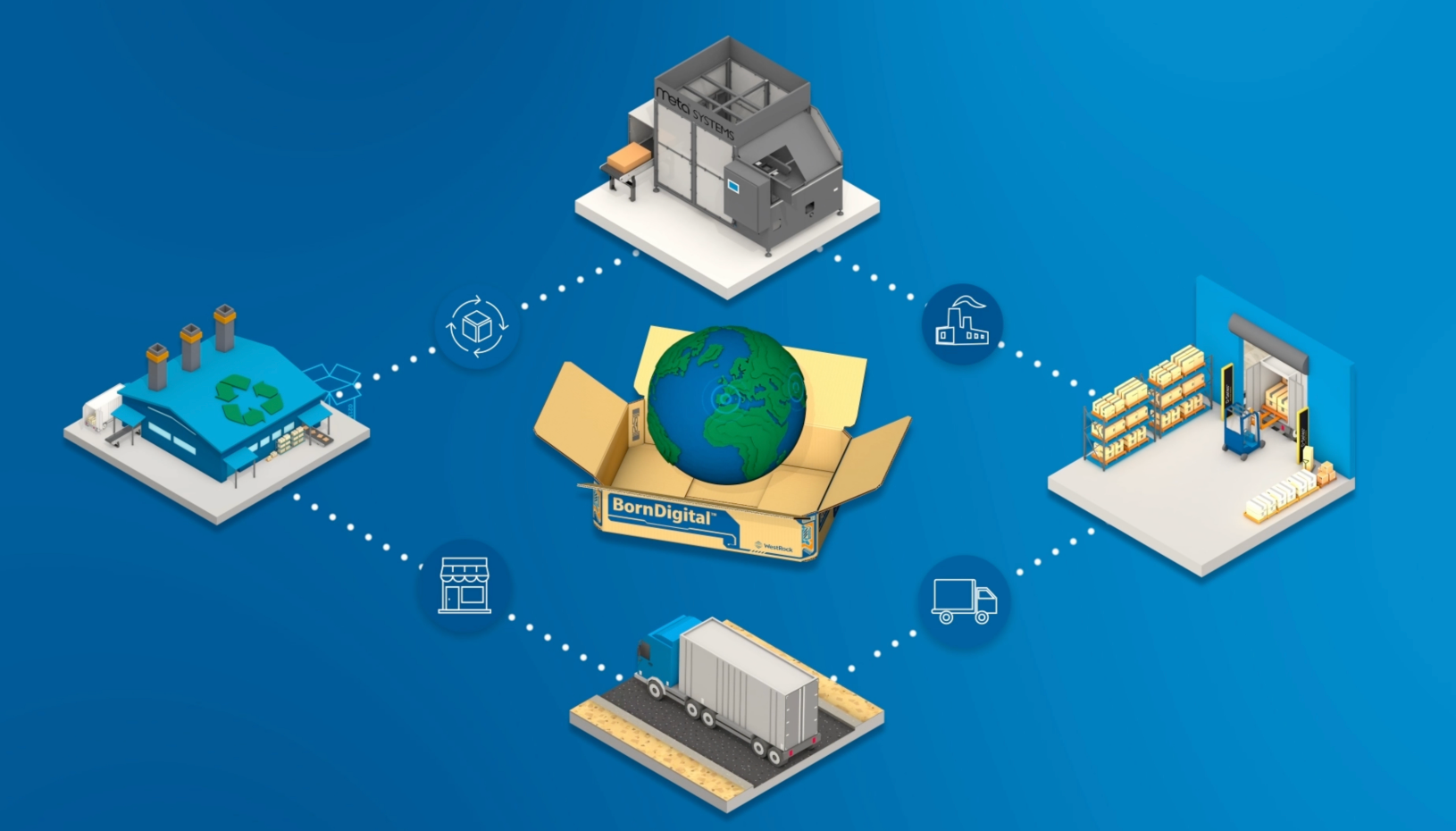
The Internet of Packaging initiative explored how connected packaging, hardware, and software could create better visibility across perishable supply chains.
Infrastructure, equipment, integrations, potential markets, and product capabilities were all still being tested at the same time.
I started by turning uncertainty into researchable questions
I ran knowledge-gap workshops with the product, technology, and commercial stakeholders. Everyone wrote down what they did not know, and we grouped those unknowns until the categories, and the disagreements inside them, were visible.
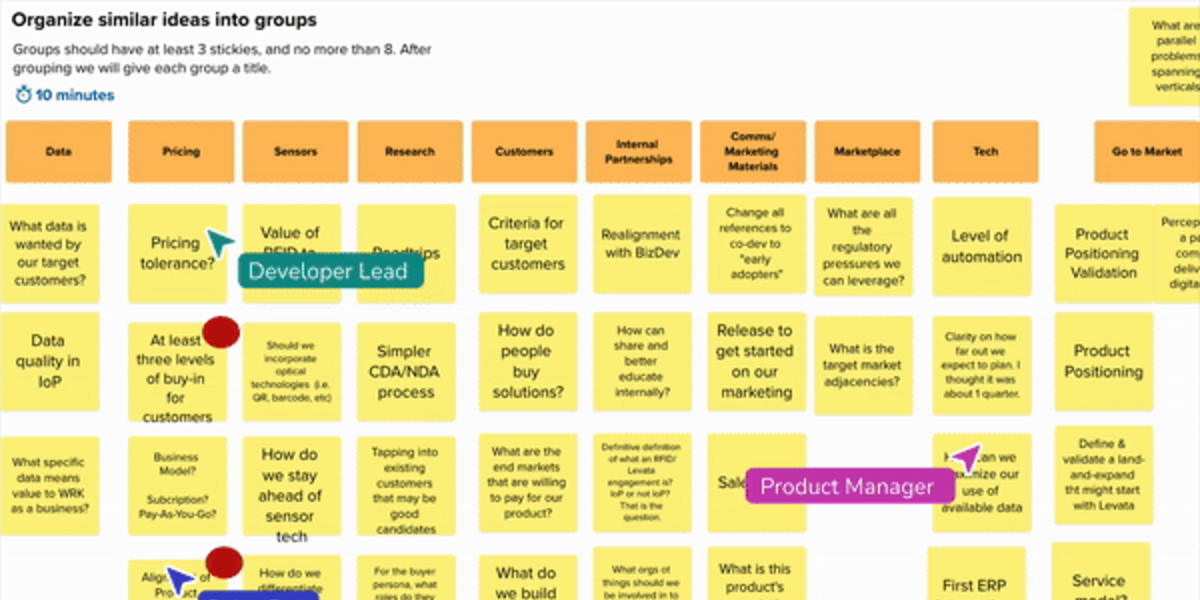
10 knowledge-gap themes
- Data
- Sensors
- Customers
- Marketing materials
- Technology
- Pricing
- Research
- Internal partnerships
- Marketplace
- Go to market
The point was not cataloging unknowns. It was agreeing on which unknowns were expensive to get wrong.
The first deliverable was not a survey. It was clarity about which assumptions were dangerous enough to investigate.
I designed a repeatable research cycle instead of a one-off study
A single validation study would have answered one question and left the team where it started. The cycle below ran against whichever gap was most dangerous at the time, and it ran again as soon as the next one surfaced.
-
{{ step.label }}
{{ step.note }}
Then start again at 01 with the next highest-risk gap.
Secondary pathway
Recruitment reached people who ran real supply chains, so some conversations went beyond the study. When a participant surfaced a packaging need or a co-innovation interest, I handed it to the team that owned it. That pathway stayed secondary to the research loop by design.
01 / Decision
Design for customers' real technology environments, not an idealized stack
A connected-packaging product only works if it can meet customers where their systems actually are. So I asked them.
-
{{ row.label }}
{{ row.pct }}
Evidence
Customers operated across uneven levels of technical maturity.
- 80% used Microsoft Excel as a system of record
- 40% still used paper
- 39% said at least some relevant devices were locked down
- Efficiency, cost savings, and security were the major adoption drivers
Interpretation
The product could not assume a modern, fully integrated technical environment.
Decision
Integration assumptions, device constraints, and the value proposition all needed to accommodate much more varied customer realities.
Research became an input to roadmap prioritization
Once evidence arrived on a recurring schedule, prioritization conversations changed shape. Instead of debating which value proposition sounded strongest, the team could look at what customers said they wanted and what they indicated they would pay for.
Evidence was useful when it changed the decision, not when it merely confirmed the roadmap.
91
participants in this documented roadmap-prioritization study, across two survey rounds
The rounds tested customer demand for candidate roadmap value propositions, explored perceived value and willingness to pay, and returned further evidence of demand for real-time data.
This figure describes that study only. It is separate from, and should not be added to, the 135 survey responses reported for the broader program.
02 / Decision
A weak market hypothesis was more valuable to stop than defend
The team had hypothesized wine as a promising vertical. Rather than letting enthusiasm turn into roadmap momentum, I used market outreach and inbound testing to look for signal first.
-
Hypothesis
Wine could be a promising vertical for connected packaging.
-
Signal
The wine-industry Google Ads campaign gained no impressions and was too slow to refine through approval. It was terminated.
0 impressions from the campaign
-
Interpretation
There was not enough evidence to justify a larger commitment to the segment.
-
Decision
Deprioritize the market and redirect effort toward stronger segments.
The campaign plan and its results are internal documentation and are summarized here rather than reproduced. The evidence helped deprioritize the hypothesis; it did not prove that wine has no market, and other activity elsewhere in the company was outside my view.
03 / Decision
Real-time temperature monitoring kept surfacing across the supply chain
Interviews and prioritization activities kept returning the same cluster of needs: real-time visibility, traceability, and temperature control. What made it convincing was who said it.
- Truck drivers
- Logistics managers
- Sellers
- Buyers
Evidence
The need appeared across multiple supply-chain roles rather than in a single job function.
Interpretation
This was not simply a technology-driven IoT feature. It connected to operational risk, quality, accountability, and visibility.
Decision
The capability moved forward in development.
It was still in development when the broader initiative ended. This is validated demand and a development decision, not a launched or adopted feature.
Research created value beyond the roadmap
Recruiting from a large prospective pool meant I was talking to people who ran real perishable supply chains. A study participant could contribute evidence, continue into a deeper innovation conversation, or reveal a packaging need that belonged to another Smurfit WestRock team entirely.
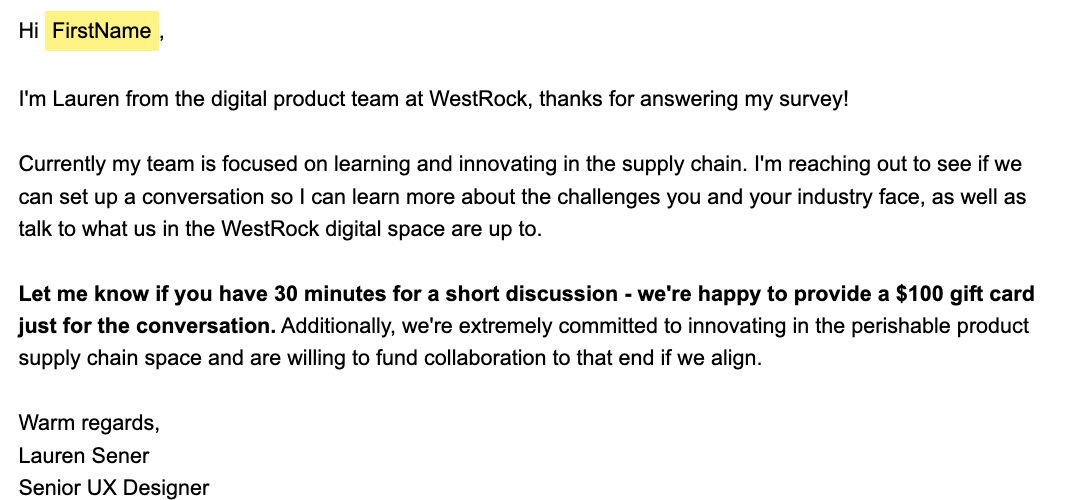
Where a conversation could go
- Contribute evidence to the study
- Open a deeper innovation conversation
- Reveal a packaging need for another internal team, which I referred on
5
packaging-business referrals generated
These are documented business opportunity referrals. I was not involved in later sales or partnership follow-through, and what happened after the handoff is outside what I can claim.
Evidence at scale
- 46K+
- prospective research pool
- 135
- survey responses
- 11
- interviews
- 5
- business opportunity referrals
The point was not volume for its own sake. The program created enough recurring evidence to challenge assumptions and move product discussions forward.
I designed the research so the evidence could travel beyond one meeting
Findings that live in a deck nobody reopens do not change anything. Each cycle ended with the evidence packaged for the specific audience that had to act on it.
- Research readoutsFor the product team, tied to open questions
- Executive presentationsDecision-oriented, on a recurring cadence
- Short insight videosSo findings reached people who missed the meeting
- Opportunity handoffsRouted to the internal team that owned the need
- Backlog and roadmap inputEvidence attached to the items being debated
The product did not reach launch, but the research changed how decisions were made
- Customer evidence became a recurring product input
- Research informed backlog and roadmap discussions
- A weak vertical hypothesis was deprioritized before a larger investment
- Real-time temperature monitoring was validated and was in development
- Five packaging-business referrals were generated
- Executives received recurring, decision-oriented research
Evidence boundary
- The larger initiative was ultimately shut down before launch.
- The five referrals are documented opportunity referrals, not completed sales or partnerships.
- I did not own later business-development follow-through.
- Research influenced decisions, but not every downstream roadmap action can be attributed solely to the research program.
I would make the decision trail easier to measure next time
The program produced evidence faster than it produced a record of what that evidence changed. With the same three months again, I would build the measurement in from the start.
A decision log
Tying each recommendation to the roadmap action it did or did not produce.
Shared definitions
- Research lead
- Qualified co-innovation opportunity
- Pilot
- Closed business
Consistent reporting dates
So counts from different moments can be compared without reconciliation.
Early research is valuable precisely when it helps a team change direction before the cost of changing becomes high.
Working through a similar kind of complexity?
I’m interested in senior UX roles where research and design shape consequential product decisions.
Next: Unifying two lending experiences around how customers actually choose · Small-business lending company · Information architecture · 2 sites unified